
From time to time, as I have been working on my current project, photographing the wildflowers and grasses of the tall grass prairie, I have wanted to share an image, or a thought, as I am working. I am also trying to get a mass-market publisher to print the soft-cover edition of the book that has resulted from this photo project. I thought that this publisher quest might be an interesting story. These are the reasons I've decided to start this slow stream of occasional updates (a slog).
A Tiny Little Flower
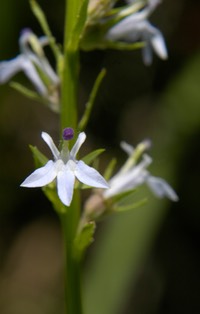
Lobelia spicata PALE SPIKED LOBELIA
Okay. I know it's been a long time since my last post on this slog (slow, periodic weblog). One wonders if you can call it a slog (blog) at all. It's been 17 months. In my defense, however, I have finished the layout, and had printed, a sample copy of book 2 - Elusive Splendor: Wildflowers of the Tallgrass Prairie. Since printing, I have copyrighted and registered all the images in that book, and I have designed and printed out an entire series of Wildflower Greeting Cards, and I have designed and printed out an entire series of Wildflower Bookmarks.
In addition to the normal activities involved in finishing up and rolling out a new book, I also attended the 23rd North American Prairie Conference 2012 at the University of Manitoba in Winnipeg, Canada, the first full week of August this year. While there, I made a presentation of all 134 wildflower species I have photographed in the first two books of The Prairie Splendor Series, which is the totality of wildflower species I have photographed.
To your right, you will find an image of Lobelia spicata PALE SPIKED LOBELIA. I was photographing in late spring and this specimen was in bloom. The species is named after Mathias de L'Obel, 16th century Belgian botanist. Spicata refers to growing ears (like corn), in spikes. Due to the pastel color of its petals, it is commonly know as pale, spiked Lobelia. I am particularly fond of the round, deep purple stigma that is in sharp focus near left center of the photograph.
Another Pretty Yellow Bloom
Potentilla norvegica NORWAY CINQUEFOIL
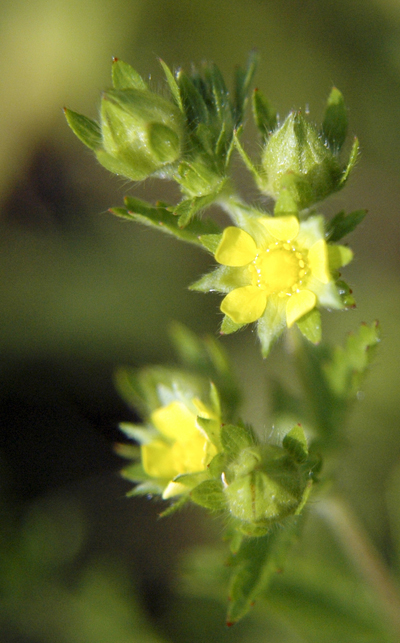
To the right you see Potentilla norvegica NORWAY CINQUEFOIL. This species is part of the rose family. Potentilla means little, powerful one, referring to medicinal properties, and norvegica refers to Norway. The common name comes from the flower that has five petals. The unusual shape of the flower head of NORWAY CINQUEFOIL is called a cyme.
Work on book two - Elusive Splendor - was interrupted by unusual pain in my chest. It turns out the pain came from occluded coronary arteries. The medical solution is by-pass grafting. The entire open heart surgery took only one day, December 8, but I spent 11 days total in the hospital. I have been home now for seven days. I'm recovering nicely, and it feels good to get back to my photography work (it feels at least as good as possible after you've been figuratively hit by a train doing 100 mph).
Five Petals, Five Leaflets
Potentilla arguta PRAIRIE CINQUEFOIL
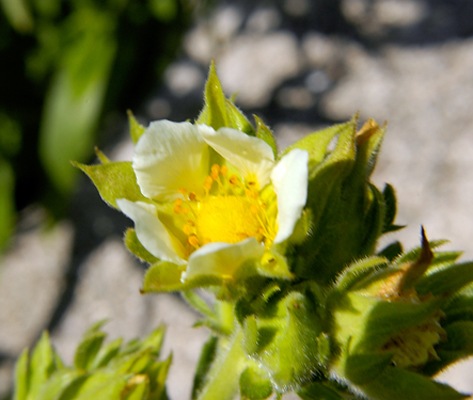
To the right you see Potentilla arguta PRAIRIE CINQUEFOIL. This species is part of the rose family. Potentilla means little, powerful one, referring to medicinal properties, and arguta means sharp-toothed. The common name comes from the five leaflets in the compound leaf; the flower also has five petals.
Work continues on the layout of book two, Elusive Splendor. I hope to have it finished and in the editing stage by mid-March.
A Pretty Pinkish
Polygonum pensylvanicum PINKWEED
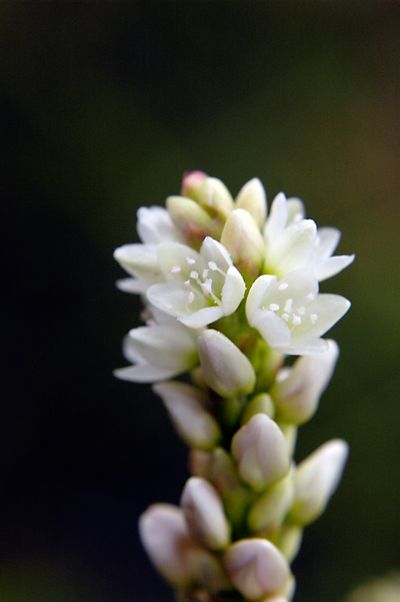
To the right you see an image of PINKWEED just starting bloom. It's a very nice little multiple flower head. Polygonum bloom just about everywhere, on prairies, along the edges of cultivated gardens, in big city allies, and between the cracks in expressways. A survivor, no matter what.
Some good news. A contemporary art gallery, the A. Montgomery Ward Gallery, at the University of Illinois at Chicago will mount an exhibition of about 20 of my prairie wildflower photo images from February 15 to March 16, 2011. This is the first major exhibition of my work at an art gallery. I am excited.
Fall Controlled Burn
Prescribed Burn 10:30:2010
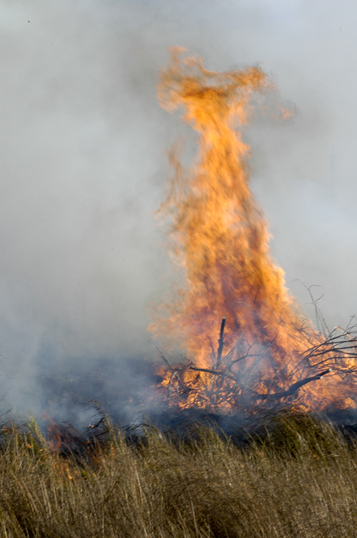
Last Saturday, a small group of volunteers showed up to conduct a controlled burn in the Peacock Prairie at the James Woodworth Prairie Preserve. In addition to burning a portion of the field, which we do each year in late fall and early spring, we had a large amount of Cornus racemosa GRAY DOGWOOD, which had been cut as part of the overall management plan for the prairie, to burn as well. The pile was from the last two years, so it was rather large. Due to unusual dryness, we knew we were going to burn the Milwaukee swale (has the most grass and usually the most water), so we decided to stack the dry dogwood stems into a pile in the center there as well. The pile ended up being about nine feet tall. It burned quickly, the entire pile reduced to ashes in about 10 minutes. To the right is a photo of that burning pile.
Curled Purple
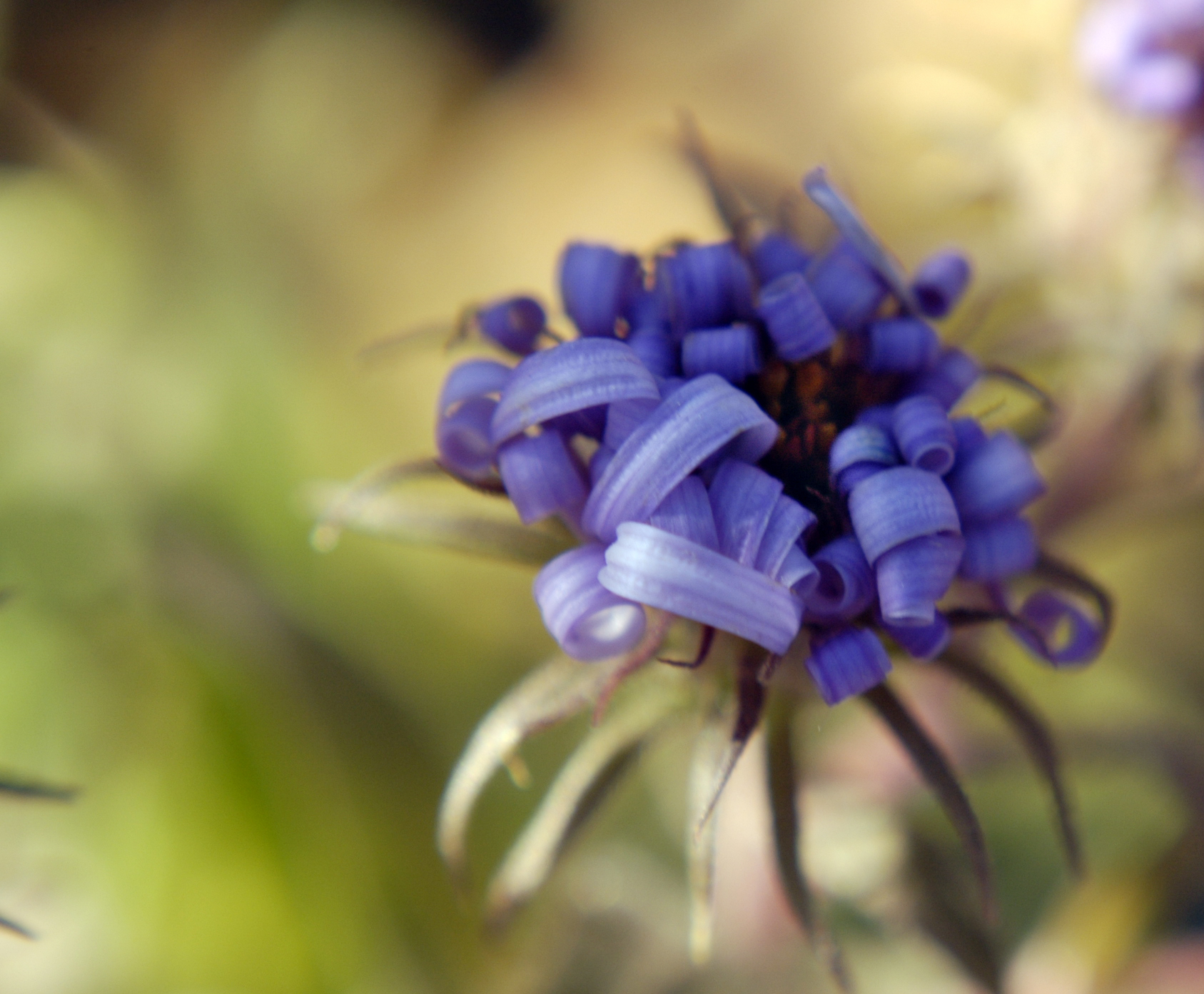
Aster novae-angliae NEW ENGLAND ASTER
Today is about five and one half months since my last update. I know this slog (slow, irregular blog) would be intermittent at best, but I didn’t think I would pause this long a time between posts. There is a reason, of course: I have been out photographing at the Peacock Prairie on the The James Woodworth Prairie at least once-a-week, if not more, starting in April, and still ongoing now a the end of October.
What a growing season 2010 has been for northeastern Illinois. First record rain for both spring and summer. Record heat for the summer, the warmest summer since weather records were started 180 years ago. Record dryness and warmth for the fall of 2010. The results have been summarized as: summer was hellish, and fall was summerlike.
The results have been record growth and record bloom. This morning, October 26, a hybrid bearded iris bloomed in my home garden. The prairie, and everywhere else, has seen amazing amounts of rebloom, plants trying to get in two blooming cycles in one growing season.
The photo to the right is of Aster novae-angliae NEW ENGLAND ASTER as one of these blooms started to open and was caught by a cool night, the ray-flowers curling in response to the cold.
Deep Pink
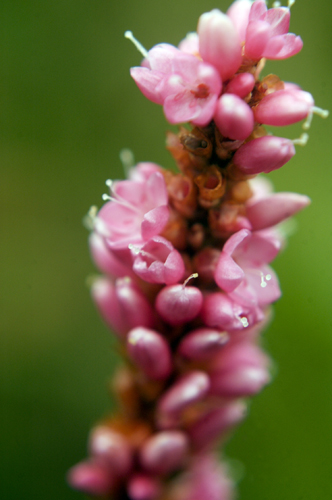
Polygonum amphibium stipulaceum WATER KNOTWEED
Over the past two weeks, I have continued to process photographs from the James Woodworth Prairie Preserve, and now I am in sight of finishing the species list for this processing cycle.
The image to the right is Polygonum amphibium stipulaceum WATER KNOTWEED. This species really loves water, often starting to grow and bloom in the Milwaukee swale after 6-10 weeks of being covered by water (sometimes up to 18 inches deep).
Polygonum means many knee joints or angles, referring to the family's stem tendency to not grow straight, but to angle off slightly at each stem joint; this species has many joints, separated by about 1-2 inches of stem length. In botany, amphibium means growing in and out of water. Finally stipulaceum means bearing stipules [The basic angiosperm leaf is composed of a leaf base, two stipules, a petiole, and a blade. The leaf base is the slightly expanded area where the leaf attaches to the stem. The paired stipules, when present, are located on each side of the leaf base and may resemble scales, spines, glands, or leaflike structures. The petiole is a stalk that connects the blade with the leaf base.]
I particularly like this species because it is one of the most colorful polygona.
White Spikes
Polygala senega SENECA SNAKEROOT

Over the last six weeks, I have processed photographs of ten more species, mainly because we have been setting records for rainfall in the Midwest section of the United States. I've tried to get out and begin taking photos of the James Woodworth Prairie, but have only been able to capture images on two occasions. The image to the right of Polygala senaga SENECA SNAKEROOT was taken five days ago. I've been photographing this species for four years and was unable to identify it, mainly because I could only find one image online, and that image was a plant with mixed white and pink in the flowers. Based on that visual preconception, I was unable to find a match in my guidebook.
Polygala means much milk in early Greek usage; this meaning stems from a belief that cattle grazing in fields with this plant produced more milk. This plant got its common name from the North American Seneca Indian's use of it as a treatment for snake bite. Other tribes used the root for respiratory problems, headache, and stomach ache.
Over the past six weeks, I have received three more rejections of my requests of publishers to commercially print Abundant Splendor: Wildflowers of the Tall Grass Prairie. 'Excellent work, but not what we do,' is the gist of the rejections.
Tall and Skinny
Plantago rugelii RED-STALKED PLANTAIN
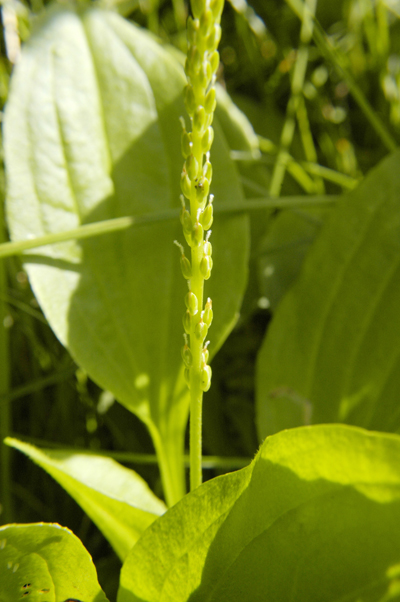
This species, Plantago rugelii RED-STALKED PLANTAIN, is commonly found in and outside of prairies. It is very adaptable and is related to plantains whose fruits (banana–like) are used for cooking and its seeds are often found in commercial birdseed products.
The genus name, Plantago, means foot print or sole of foot and refers to the broad leaves. The epithet, rugelii, refers to Ferdinand Rugel, 19th century American botanist in the southeastern U.S.
The image at right shows the flower stalk early in bloom. You can see the white stigma protruding from the very small green flower. Light brown anthers will shortly appear. Due to its bloom size, this species is difficult to photograph. I don’t have a good magnified view of the flower at full bloom, but I hope to have captured a quality image before I complete the layout of my second book - Elusive Splendor: Wildflower of the Tall Grass Prairie. Time will tell.
Bumpy
Physostegia virginiana arenaria PRAIRIE OBEDIENT PLANT
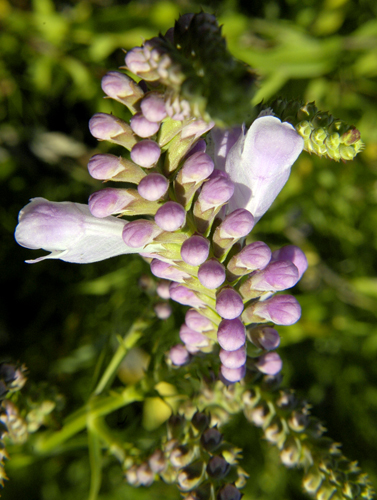
This plant, Physostegia virginiana arenaria PRAIRIE OBEDIENT PLANT, is unusual because you can push the flowers to a new position and the flowers will stay there, at least for a good while (hence the common name). Because the flower is bladder shaped, roughly like skin bladders used to carry wine in Roman times, its genus name is physostegia (bladder covering), its epithet is virgianiana since this species was found in Virginia originally, and the third name is arenaria because it grows in drier, well-drained (sand-like) soil.
The image to your right is a top view looking down on a bloom spike just as two flowers are opening. The other purple 'bumps' are flower buds which will open in due course. This is one of the species that will be featured in my second book: Elusive Splendor: Wildflowers of the Tall Grass Prairie.
I've received another rejection letter concerning publication of my first book, Abundant Splendor: Wildflowers of the Tall Grass Prairie. That makes the 32nd rejection of my work. "While it seems like very interesting work, it is not quite right for our current list." They've essentially said, 'you're not bad, just not our type.' And life goes on.
